


This is the second article of three from Issue 24 of Works in Progress that will be sent out before it starts arriving with subscribers next week. Subscribe in the next few weeks to receive it, and future issues, straight to your door, workplace, or institution.
Cities are often centers of agglomeration, places where people gather to collaborate with one another. But this is not the only reason they exist. Sometimes, cities are chiefly centers of consumption, where elites gather to devour resources extracted from the rest of the country. And occasionally, they are something like prisons, where troublesome social groups are concentrated so that the authorities can keep an eye on them. Many premodern cities, like Versailles, Naples, or Imperial Rome, were a little like this. But perhaps the greatest example was Tokugawa Edo.
Between 1600 and 1868, Japan was dominated by the Tokugawa family. The Tokugawas had prevailed over their rivals after a series of civil wars, establishing a sort of dictatorship known as the Shogunate. They developed a remarkable social system, crafted to preserve their power, and with it, the peace and social stability of Japan. At the apex of this system was the city of Edo (today’s Tokyo), at times the largest city in the world, and one of the strangest urban structures in history.
The Tokugawa social system
In early modern Europe, most people were tenant farmers, who paid rent to landowners. The state sometimes taxed landowners, sometimes tenants, and sometimes both through consumption taxes. In peacetime, however, the early modern state did not do very much, so taxes generally ran at just a few percent of national income.
The picture in Japan was profoundly different. The peasantry was directly taxed by the government, at rates varying from 15 to 70 percent of the harvest, with 40 percent as a rough norm. The authorities distributed most of their tax receipts to the samurai, a hereditary, quasi-noble class making up about six percent of the population. In both cases, the agricultural surplus ended up in the hands of a leisure class, but the Japanese system was structured very differently, with the surplus reaching the leisure class only through the funnel of public taxation.
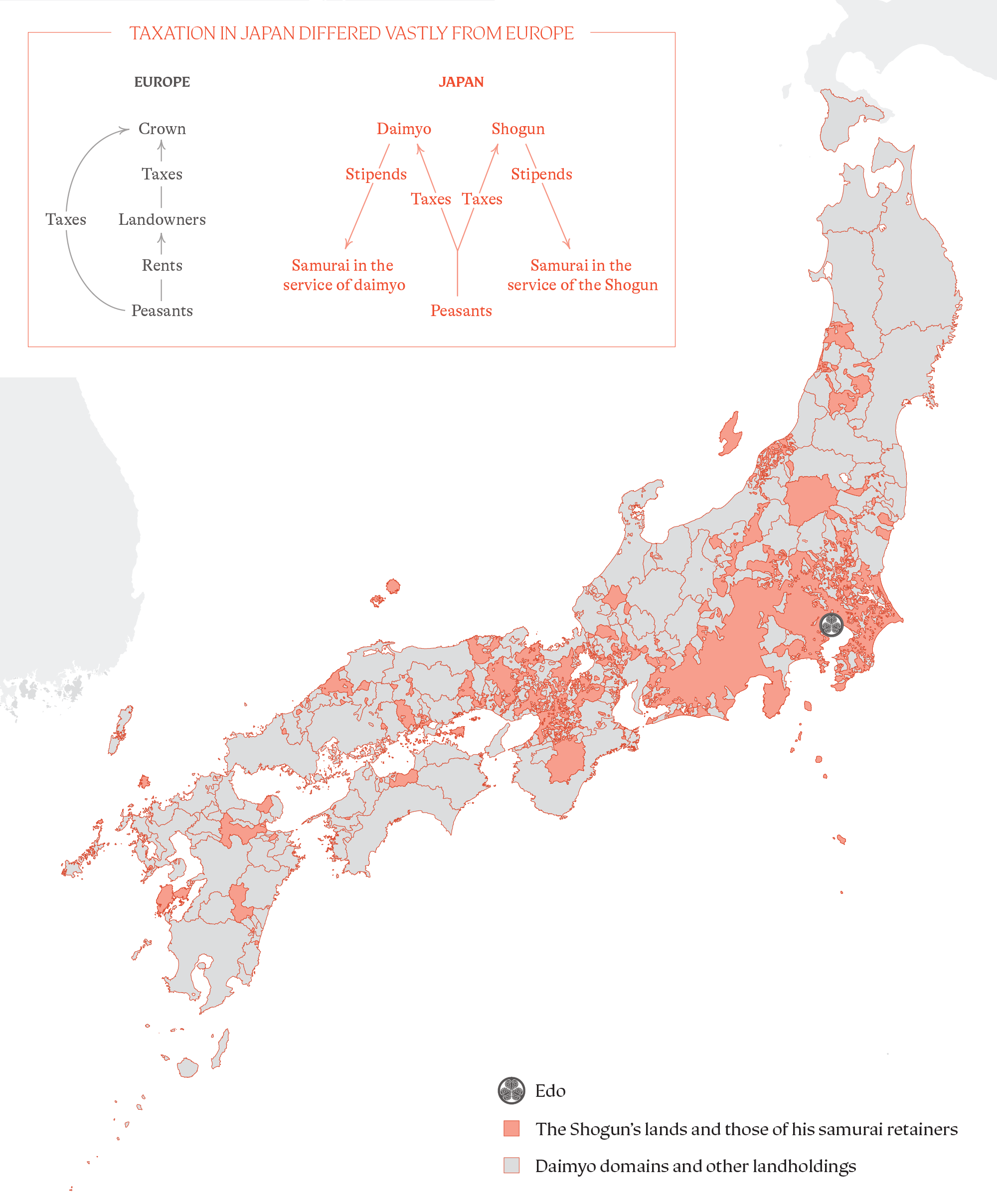
Measured by agricultural output, about 15 percent of Japan fell under the direct control of the Shogunate. These were areas that had always belonged to the Tokugawa, or that had been conquered by them during the civil wars. About a tenth of samurai were Tokugawa retainers, who received their stipends directly from the Shogunate.
In about three quarters of Japan, the tax authorities were a different group, the daimyo. The daimyo had originally been the territorial nobility, and in the pre-Tokugawa era, the breakdown of central authority had left them as the effective rulers of their domains. After 1600 the surviving daimyo submitted to the Tokugawa and were rewarded with a role somewhat akin to that of regional governors. There were about 260 daimyo, and about nine tenths of samurai were their retainers.
Urban design as a panopticon for the nobility
The city of Edo played a crucial role in this system. The daimyo were required to maintain mansions in Edo, in which their families were obliged to live permanently. Any act of disloyalty by a daimyo would thus place his family in the gravest peril. Most women of the daimyo class passed their lives as effective hostages of the state, never visiting the domains that their husbands, fathers, and sons governed. The daimyo themselves were also required to spend alternate years or half-years in Edo, bringing with them great crowds of samurai retainers. Edo thus had a dual nature: on the one hand, it was the apex of Japanese society, in which the country’s agricultural surplus was consumed; on the other, it was a kind of prison, in which Japan’s potentially dangerous elites were contained and monitored.
This gave Edo a peculiar demographic and economic character. For one thing, it was enormous. Japanese rice agriculture was extremely productive by premodern standards and generated a huge surplus for the capital’s benefit. Edo’s population seems to have been over a million by 1700, which would make it the largest city in the world at the time: London reached a population of a million only around 1800, while New York did not reach it until 1880.
It was also extremely top-heavy socially. Unlike the knights of the European feudal system, Tokugawa-era samurai were usually required to live in cities. The Shogun’s own samurai were permanently concentrated in Edo, while each daimyo brought hundreds or thousands of his samurai with him during his years of residence in the capital. This meant that almost half of Edo’s population at any given time were samurai.
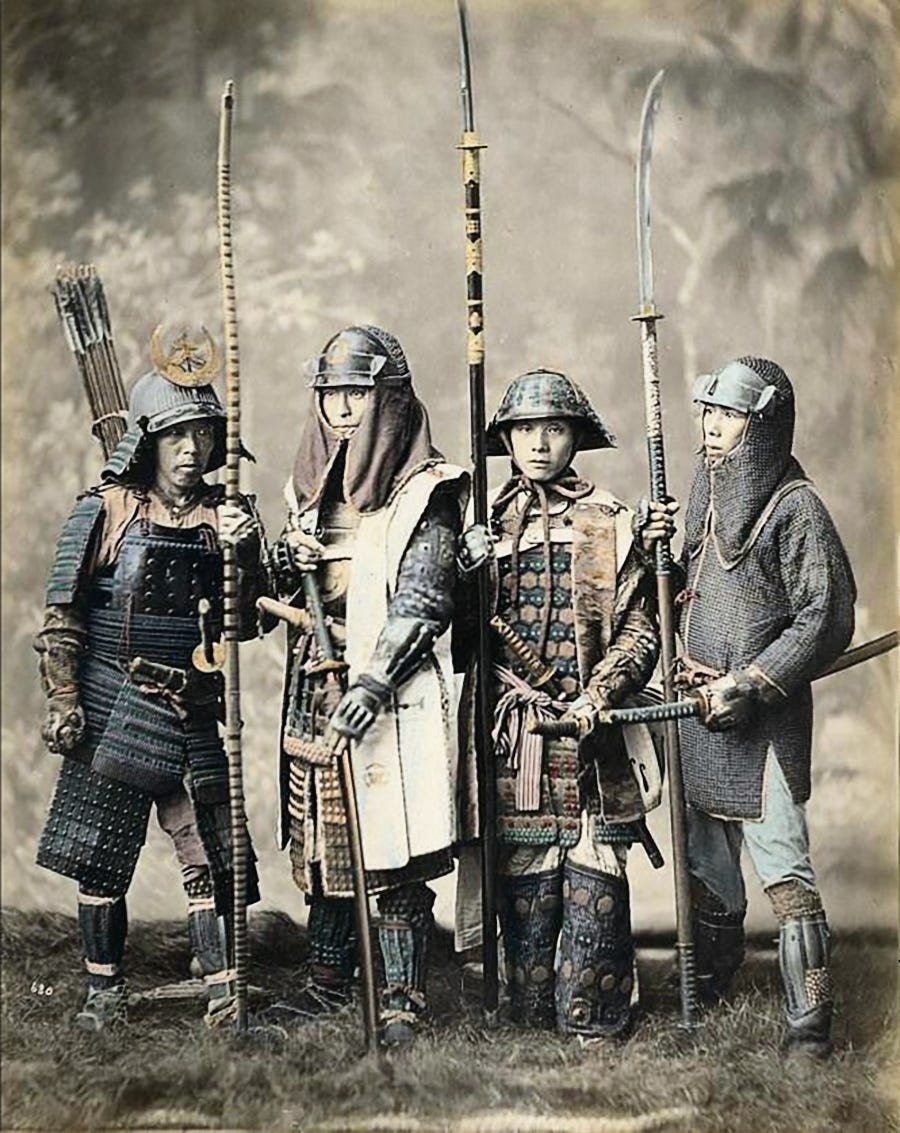

The samurai were theoretically a warrior class, but since Tokugawa Japan was at peace, there was little real soldiering to do. Most non-military work was seen as degrading, with the exception of gentlemanly occupations like civil administration and tutoring in calligraphy. Most samurai thus lived as pensioners of the state, deriving the bulk of their income from hereditary government stipends assigned to their families at the start of the Tokugawa era.
Stipends were generous for high-ranking samurai but very modest for the majority: in 1876 the Japanese state calculated that only 5.1 percent of samurai had stipends worth more than 100 yen, equivalent to a little over $4,000 today. The result was that most samurai lived in dignified but extreme poverty. It is a testament to the primacy of status among human ends that, although some samurai surreptitiously took on side jobs to supplement their tiny incomes, very few abjured their rank to take up more gainful occupations openly. Interclass marriages were forbidden, and there was theoretically no process for ennoblement, though some wealthy commoners worked around this by arranging to be adopted into impecunious samurai families.
The High City
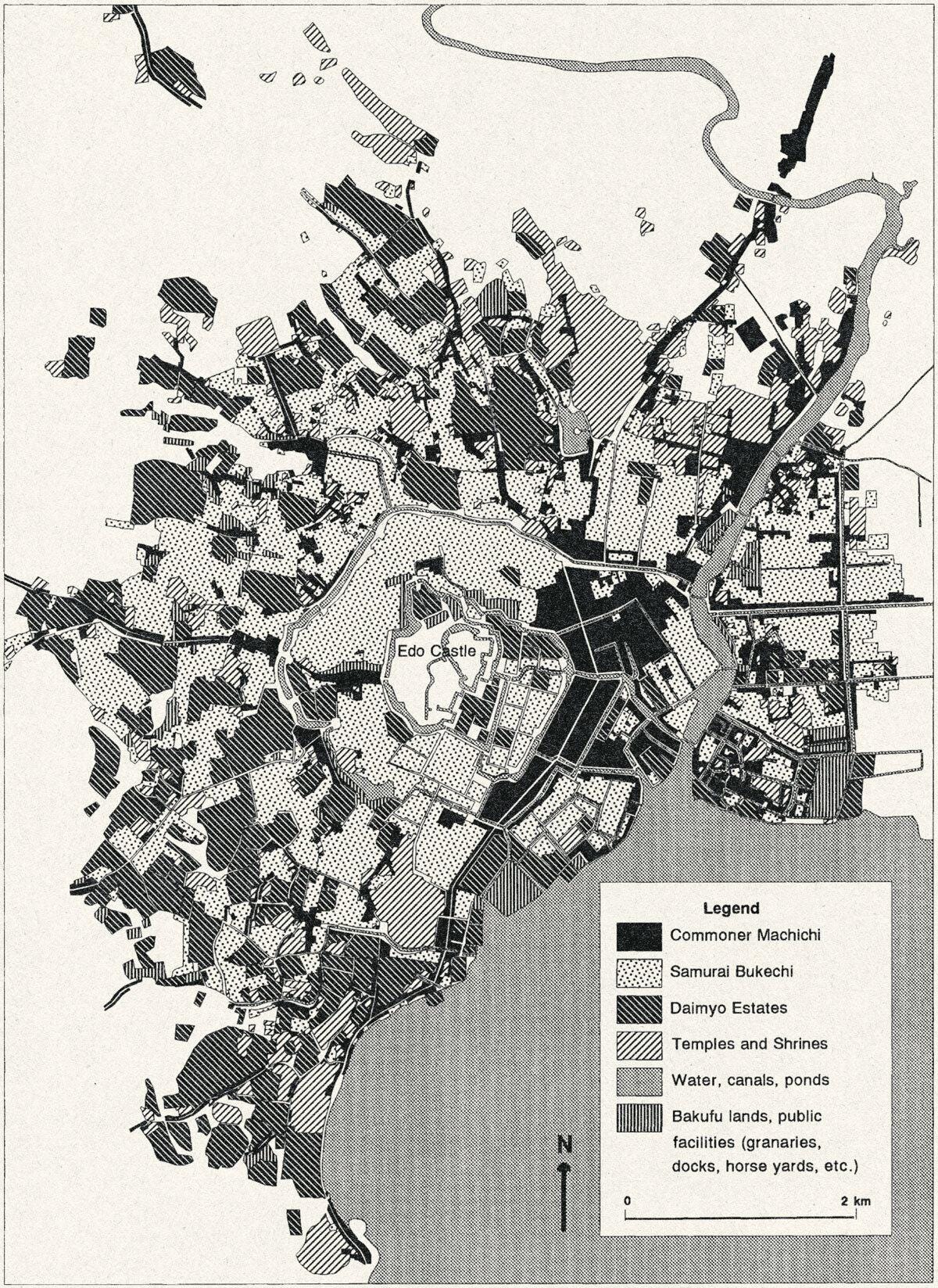
Edo was zoned according to social class, probably the largest-scale use of zoning before modern times. Samurai neighborhoods made up a large minority of the total surface area, concentrated in western areas that came to be known as the High City. Higher-ranking samurai had substantial homes, but most lived in extremely austere conditions: the median family lived in a tiny, two-room rowhouse with no garden and communal latrines.
The samurai shared the High City with the daimyo. Each daimyo was expected to maintain several estates in Edo, including a more compact estate near the Shogun’s castle and a more spacious garden estate further out. These were made up of single-storey buildings connected by covered walkways, set amid exquisitely landscaped gardens. Each estate was surrounded by a perimeter wall broken by just one or two richly ornamented gates. The great expense of all this was, from the Shogunate’s perspective, part of its appeal: the more resources daimyo expended on maintaining mansions and circulating between them, the less remained for fomenting trouble.
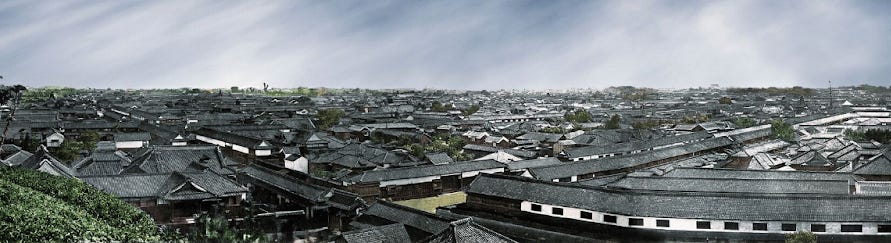

These samurai and daimyo neighborhoods made up a substantial majority of Edo’s surface area. In some ways, they foreshadowed affluent American suburbs, though they would have felt quite different at street level. Physically, the closest modern parallel might be elite neighborhoods in countries like South Africa or Brazil, where fear of crime has driven the wealthy behind high walls and electric fences.
In fact, however, Edo seems to have been an unusually safe city, a fact that often struck early Western visitors. Most people had no locks on their front doors. The English writer Isabella Bird wrote that a solitary foreign woman could travel in Japan in ‘perfect safety’ and that she had never encountered ‘a single instance of incivility’, though at home she would often have been ‘exposed to rudeness, insult, and extortion, if not to actual danger’. The walls and gates of the High City may thus tell us more about elite culture and status display than they do about any distinctive security needs.
The Low City
Much of the rest of Edo’s surface area was taken up with religious complexes and institutional buildings belonging to the Shogunate. The commoners were crowded into the remainder, mostly in riverside areas known as the Low City. Though most commoners were very poor, some were richer than most samurai, and even richer than minor daimyo. Some of the greatest artistic legacies of Tokugawa Japan, like ukiyo-e prints and the kabuki theater, arose from the patronage of this class. However wealthy they might become, however, commoners’ status was axiomatically lower than that of the samurai.
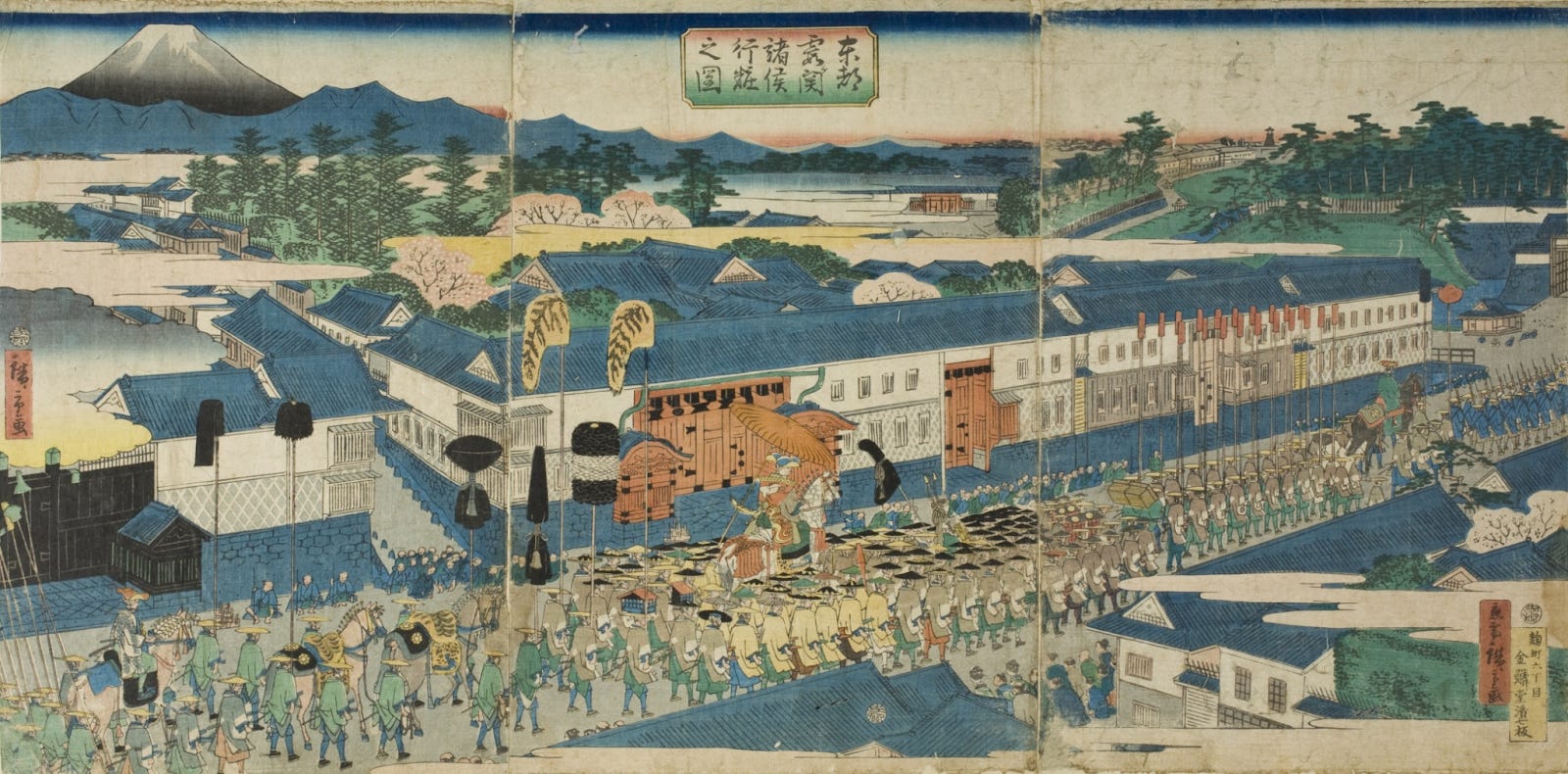

Edo’s commoners worked mostly in providing goods and services to the city’s elite. The city as a whole produced little, consuming resources from the rest of Japan and providing little in return save the arguable gift of government. No international trade took place in Edo: the government was intensely wary of destabilizing foreign influences, and by the late-eighteenth century it allowed only two Dutch and ten Chinese ships to visit Japan each year, all through the carefully controlled port at Nagasaki. (For comparison, about fifteen thousand ships arrived in British harbors from foreign ports annually in the same period.) In this as in other respects, the Shogunate’s political needs had a decidedly fitful relationship to the country’s economic growth: although the political stability that the regime provided certainly did foster prosperity, the steps it took to ensure that stability often stifled it.
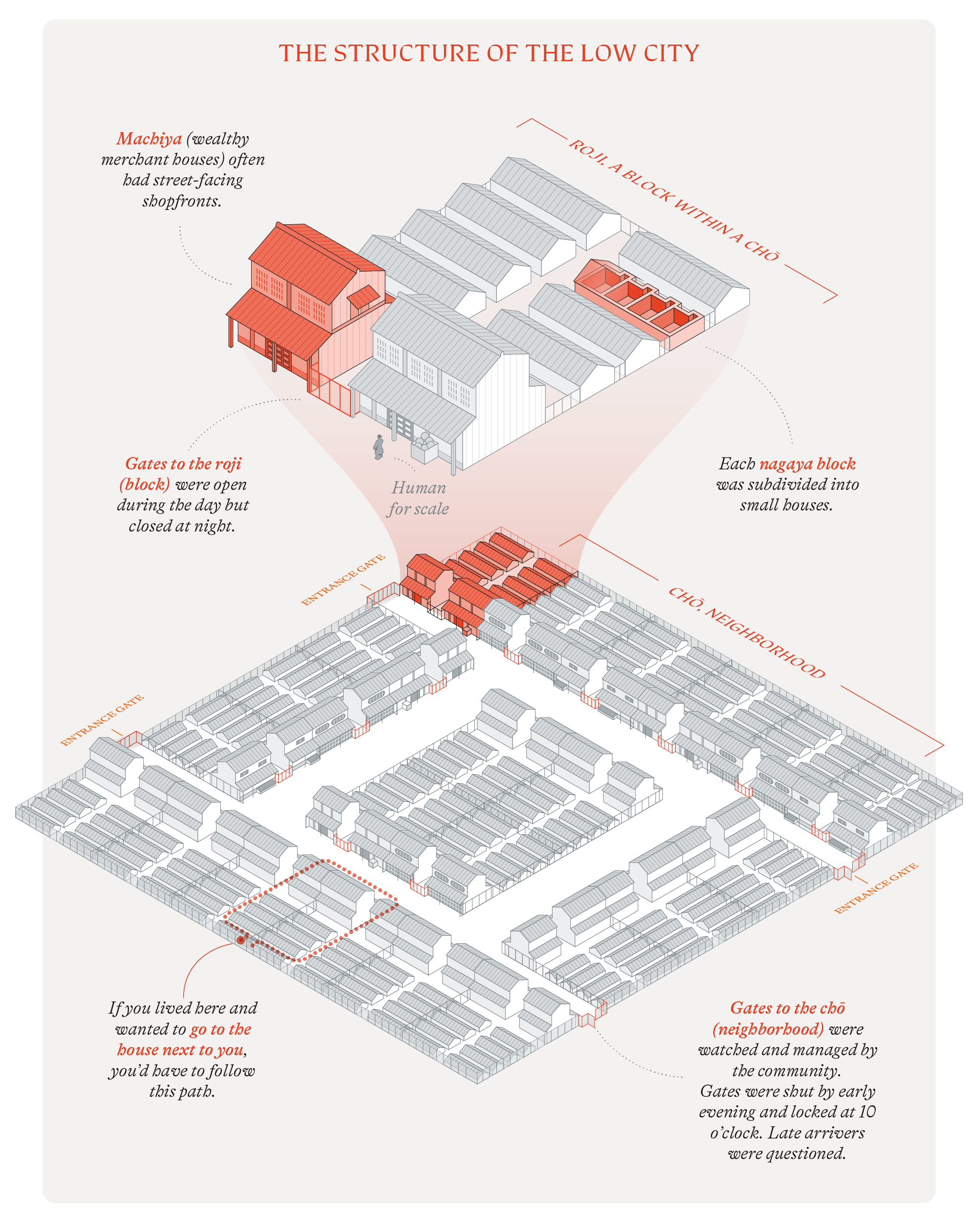
The physical form of the Low City was even more remarkable than that of the daimyo neighborhoods. Commoner Edo was divided into some 1,500-2,000 fenced and gated blocks called chō. These were then subdivided into roji, alleys lined with small houses, often also gated. The Low City was thus divided up by many thousands of internal checkpoints, all of which closed at night. Edo was not under threat of attack in the Tokugawa period and the city as a whole was not fortified. The purpose of this immense labyrinth of walls and gates was to control and monitor the movement of the population.
Wealthy merchants lived in substantial houses called machiya, featuring a series of small garden courtyards around which living spaces were ingeniously laid out. In plan, machiya recall the domus house type of the urban middle and upper classes in the Roman Empire. Many machiya must have been rather agreeable houses, and some Japanese people still live in modernized machiya today. Most commoners, however, lived in nagaya, tiny terraced houses frequently built back-to-back. A standard specification for nagaya was 2.7 meters wide and 3.6 meters deep, yielding a total floorspace of only 13.2 square meters.
An enormous number of people were crammed into commoner neighborhoods. The most crowded had 58,000 inhabitants per square kilometer, about twice the population density of Manhattan today. Remarkably enough, however, their dwellings were largely single-storey. This seems to have been required by regulation, in turn motivated by fire risk or by dislike of commoner buildings towering over the mansions of the nobility. Japanese builders were perfectly capable of erecting taller structures, so the fact that these intensely crowded neighborhoods forewent the floorspace that additional storeys could have provided is not least among the paradoxes that Tokugawa Edo presents to history.
* * * *
In a way, the Tokugawa system was a success. Japan experienced near-total peace between 1600 and the late nineteenth century, a remarkable achievement for a premodern society and a dramatic contrast to Europe or China, where tens of millions of people died in wars. The Tokugawa succeeded in bribing, blackmailing, and intimidating Japan’s armed elites into a quarter of a millennium of passivity, enabling steady economic growth and a remarkable artistic flowering. One might thus argue that Edo’s apparent parasitism was an illusion. Edo was indeed a gilded prison, but prisons can be useful things.
Still, it would have been nice if Japan had not needed a vast prison capital in the first place. Tokugawa Edo stands as a monument to the power of rent-seekers, producing little and demanding immense resources as a condition of civil peace. It shows how the physical form of cities may be reshaped by these demands, as governments apportion space and limit movement in line with their political needs. These forces yielded a city with tight restrictions on built density and land use, an acute housing shortage, and a huge share of privileged state stipendiaries. Edo is a particularly striking example of these phenomena. But it is far from alone.
Samuel Hughes is an editor at Works in Progress. Follow him on Twitter.
Thanks to Fabian Drixler for generous help.
Wow! what an informative essay. Thank you.
In general, it was a divide-and-conquer policy that kept the peace, more important in my eyes than keeping hostages in Edo. Especially in the early years when they daimyo still had some military capabilities, the Tokugawa bakufu could and did transfer powerful daimyo to new domains where they had no local network. The lands directly controlled by the bakufu were also crucial from a strategic perspective - Osaka and Kyoto were the centers of manufacturing, Nagasaki the gateway for foreign commerce (which was mostly with China/Korea), the bakufu directly held the gold, silver and copper mines and so on.
As to the Edo alternate attendance, one function was to impoverish the Daimyo: rebellion is hard if you can't afford to purchase arms. You do pick that up.
Tax rates have to be taken with a grain of salt, because the price of rice did not rise when incomes rose, nor were cadastral surveys updated when yields increased – Japanese farmers were quite sophisticated in seed selection, writing about farming techniques and diffusing new cultivars across "han" boundaries. So the effective tax rate on agriculture fell, with lots of regional variation. More important, as the economy developed over time – including the growth of industry in and around Edo, after all there was no city there in 1600 – stagnant taxes calculated in bags of rice meant that "han" incomes failed to keep up with the rest of the economy. While some "han" were able to support one or another local industry, many weren't in good locations. [I argue that by 1720 the core regions of Japan constituted a "modern" economy in sense of De Vries and Van der Woude, but economic history isn't your focus. Decades back I edited a 7-volume series on Japanese economic history...]
Anyway, you do pick up important threads of why there was 250 years of peace. In fact you could argue that because the fall of the bakufu in 1868 was quick, with little fighting, it really constituted a coup d'etat not a civil war. Later wars (with China, Russia, a little bit during WWI and then the 15 Years War with the takeover of Manchuria in 1931) weren't fought on the Japanese home islands. So the last civil war in Japan ended in 1600, and while there was bombing aplenty, there was no land war in Japan proper during WWII. Disingenuous, perhaps, but by that reckoning Japan has gone 500 years without widespread domestic conflict.